Lemurs and Chameleons by Day and Night

Ranomafana, Madagascar 
August 19, 2015

The forest beckons
The dining room
The girls discussing the day ahead

Lovely spot here on a hillside overlooking the forest and situated in a well kept garden. We all had individual huts which were spacious and comfortable. The beds were equipped with mosquito nets. The dining area had an outdoor deck from which we could look down on the road winding into the nearby village. Here at last we had a glimpse of the lush, green Madagascar we had expected.

One of our first sightings of a lemur

The morning was spent walking in the forest, looking for Lemurs of which we found five species. However, on first entering the forest we were shown a Satanic Leaf-tail Gecko on the trunk of a tree next to our path. His camouflage was so good, that even when we looked straight at him, it took us a while to separate him from the leaf-litter around about and had to have his eyes, limbs and tail pointed out to us. In fact, some people, including Joy didn’t distinguish his features until careful study of her photographs later. 

Satanic Leaf-tail Gecko

The first Lemur we found was the Golden Bamboo Lemur. Difficult to spot and Austin only glimpsed the end of a tail, though Joy did obtain a good photo. Photography was difficult due to low light created by the dense canopy. An additional problem was that our group was joined by others and some crashed through the bush trying to get a look and of course frightened the animals away. At the same site, a small group of Milne Edwards Sifaka were spotted and again there was a general rush to see and photograph the same. These largest of the local Lemurs are black and white and performed extremely agile leaps from tree top to tree top. At one point we came out to a viewing platform, providing magnificent vistas over the surrounding forest. Here we were amused for a while by a small, bright green Madagascar Day Gecko with brownish-red spots and bright blue tail, sliding around the posts and beams of the platform.

Our friendly Madagascar Day Gecko
Looking out across the Ramonafana National Park

Wandering on for a while, Robyn tripped and landed on the muddy stoney path. As we stopped to pick her up, we realised that a few Red-fronted Brown Lemurs were just overhead. After oohing and aahing and photographs, we moved on to find a pair of Red-bellied Bamboo Lemurs eating wild oranges and then again moved on to find two sleepy Giant Bamboo Lemurs high in the bamboo forest. A great introduction to the Lemur family.

Red-fronted Brown Lemur
Red-bellied Bamboo lemur eating wild oranges
Village kids
The rickety bridge

Before we came to Madagascar, we didn’t realise that Lemur habitat is extremely restricted due to a long history of logging and forest destruction for charcoal production – the main household fuel. Today, reserves for Lemurs and other wildlife consist of small remnant pockets scattered across the island. Ranomafana is one of the largest reserves at 41,600 ha (161 sq miles) of tropical rainforests and is part of the World Heritage site, ‘Rainforests of the Atsinanana’. Adjacent the Park is the Centre ValBio Research Station, managed by Stonybrook University, where much study is undertaken of these endangered animals. 

The afternoon was a rest time before a short tour of the local village with its chickens, dogs, shops and kids. A number of us bought bone earrings from one of the small roadside shops. Crossing the river on a winding, rickety bridge (with the remains of previous flood-washed away bridges around us) we walked around to the hot springs area. Here there was a large fenced-off swimming pool for paying clientele. However, it was good to see that there was also another smaller hot springs fed pool free to be used by local children and their families. On the way back through the village, we visited a women’s weaving cooperative, where a number of ladies bought colourful and finely-textured silk scarves and wraps. We watched the shy but friendly women at their skilful work.

Weaving at the Ladies Cooperative

A night walk along the road before dinner was a highlight of our stay. We found (strictly our guides found) two Rufous Mouse Lemurs with their big bright eyes (when they weren’t having a quick snooze), in the scrub along the roadside. The guides paint some sugar mixture on trees which attract these delightful glider squirrel-like animals. We also saw a brown tree frog and five different species of Chameleons, from a tiny bright green one about 8 cm long to a O’Shaughnessy’s Chameleon with its green and rusty brown mottles at 40 cm length. There was much competition among our party to spot chameleons with their superior torches and photograph them with their superior cameras – and numerous cries of frustration as camera flashes upset the lighting conditions of others vying for the same shot.

The cute Rufous Mouse Lemur
O’Shaughnessy’s Chameleon
Tiny Perinet’s Chameleon
Lala and his family joined us for dinner

Culture and Crafts

Ranomafana, Madagascar 
August 18, 2015

Before leaving town today we dropped into a home craft industry where the men make toy bicycles, motor-bikes, rickshaws, trucks etc from waste materials. Used drink cans were fashioned into car and truck chassis’ and bicycle rims. Fishing line was used for bicycle spokes and tyres were made out of disused medical tubing painted black. The overall appearance was quite stunning in its scaled accuracy and detail. Very clever. When people chose to buy a model, our toy-maker cut the end off a plastic drink bottle, placed the model inside, replaced the end and taped them up – once again, recycling available materials. Surely we in the West could learn a thing or two from these environmental artisans. The women produce embroidered table cloths, tables runners and children’s clothes. A number of our ladies brought items for their grandchildren.

Embroidering tablecloths
The amazing toys made from 100% recycled materials

A long drive today to a Lemur Forest Reserve. Some of the valleys along the way had watered rice fields with new rice being planted or freshly planted out. Ducks and geese enjoyed the watered fields. Zebu cattle and the occasional goat were tethered here and there across the fields. Later in the day, as the road climbed higher, there were more cattle and the crops were finished.

We slowly climbed our way up into the mountains, until we stopped at the town of Ambositra. Here we visited a wood carver’s shop and admired the fantastic skills of the tradesmen. We watched spell-bound as we witnessed the manufacture of intricate marquetry created on an ingeniously home-made fretting saw which incorporated amongst other things, an old bed spring. The extremely fine saw blade was made from high-tensile steel reinforcing, removed from old radial tyres, each tooth being painstakingly cut by hand with a chisel. In the shop next door, there were lots of marquetry artifacts for sale, including jewellery boxes, letter racks, serviette rings, nativity scenes and religious icons. We didn’t buy anything but I’m sure we would have if we had more time.

Pig market along the way
This little piggy went to market
Typical housing in the country
Zebu and rice in the drier hills
Wood carving (what’s Occupational Health and Safety?)
Marquetry manufacture
The girls
The boys
The lunch

Time for lunch at a resort in town. Here we were welcomed by a troupe of dancers and musicians performing local folk song and dance, lining the path to our lunch table. The girls were dressed in white lacy dresses and the boys in black pants and bright red shirts. All were barefoot and wore broad-brimmed straw hats. They were accompanied by drums and accordion. Very enjoyable. Lovely traditional Malagasy food but far too much for any of us to finish. 

A further 90 km drive to Ranomafana Forest Reserve and the Setam Lodge, where we are to stay for the next two nights. Excited about seeing our first Lemurs in the wild tomorrow – in the footsteps of Attenborough. 

The two of us
Back on the road
Just hangin’ out
Evening light near Ambohimahasoa
Our mountain retreat
Our garden bungalows

Ambatolampy and Aluminium

Antsirabe, Madagascar 
August 17, 2015

Early start for our Malagasy adventure. Breakfast was ordered at reception from a French menu for a Petit de Jeurner – eggs, bread rolls, small tubs of yogurt etc. Joy had fun translating the French, so that we knew what we were ordering. We ate at small tables at one end of the compact lobby. After breakfast we met our guide Lala for a briefing. We were surprised to find that he had recently been to Melbourne in company of a young Malagasy boy who needed some specialised surgery. The contrast between conditions in Australia and those here is stark.  

Antananarivo countryside

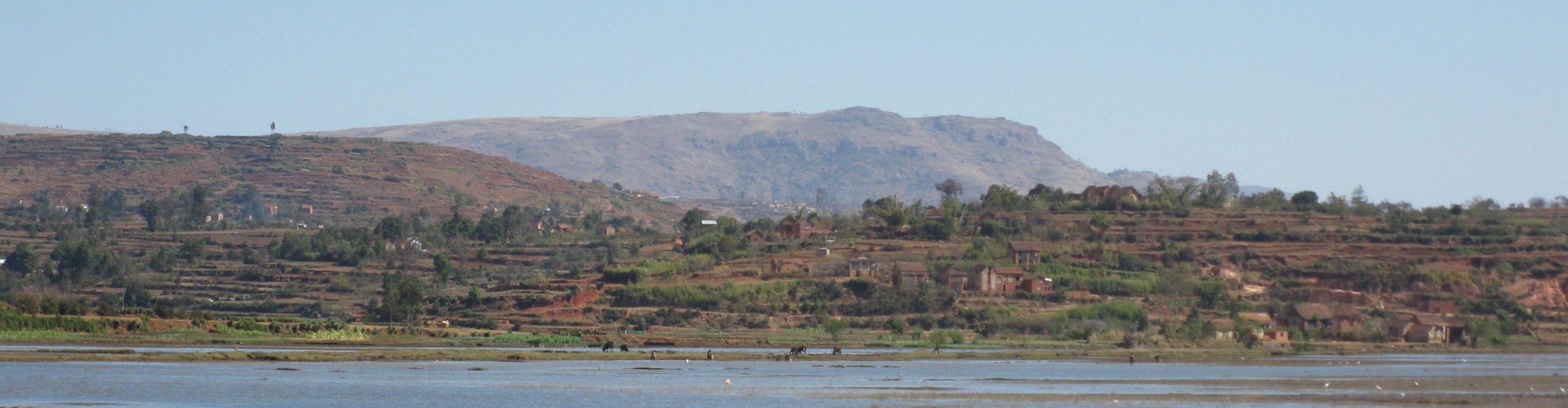
As we boarded the bus, we were pressed by ladies in the street outside our hotel selling intricately embroidered tapestries depicting Malagasy village scenes. We headed south to Antsirabe. Small paddy fields are the major unit of agriculture but most are dry at this time of year – being used to grow vegetables (mainly peas) or wheat or rough grazing for Zebu. Not far out of town we stopped by the side of the road to look across a valley of rice terraces being ploughed by oxen and two-storey mud-brick farm houses. From a distance these houses look almost Western standard but on closer inspection, the construction was very simple and there was no glass in the windows.

Village and terraces outside Antananarivo
Village children

We were soon met by a group of shy and fascinated children from the settlement, probably of late primary to early secondary age. We asked our guide why they were not at school and he described the concept of ‘mora-mora’ which means ‘slowly, slowly’ or ‘take it easy’. Sort of equivalent to ‘no worries, she’ll be right mate’.

We stopped at Ambatolampy to visit a backyard aluminium saucepan production centre, where scrap engine casings are melted down by the kids after smashing them into pieces. Moulds are made in ash for pouring in the hot metal. The workers use their bare feet to tamp down the ash. Still in bare feet they pour in the molten metal and remove the new pot and lid. The air is filled with ash particles and goodness knows what contaminants. The workers were skilled and cheerful. The aluminium wares from this village are sold all over the island and are even exported to Reunion, particularly the large cooking pots with lids.

The factory
The resource
The mould
The product
The chooks

After our ‘factory’ visit, we went for lunch at a village home set up for passing tourists. It reminded us of a similar experience in far west China. Pasta-vegetable mix, chicken pieces and pineapple fritters. Ambatolampy seemed to us to be a frontier town with its dusty streets, open-fronted stalls selling all sorts of produce, included fly-covered cuts of meat and with chickens, pigs and mangy dogs roaming everywhere. This is not the lush, green-forested, country-side we were expecting.

After lunch we had a guided tour through the paddy fields and back-blocks of the village, discussing the crops along the way. Some industries we noted were water cress production, small coffee plantations, soap manufacture from tomato, Buddleia ash, Aloe and animal fat. The poverty in the streets was rather confronting as we made our way through a market of clothing, food stalls and bric-a-brac to a Boules Playing Field and back onto the bus.

Ambatolampy meat stall

Accommodation in Antsirabe was in a Western-style multi-story Hotel with a large entrance lobby and dining room. Certainly more up-market than our Tana stay. The evening meal (fish for Joy, steak for Austin) was superb.

Grain store
Local transport
Lunch
Terrace farming
The market
Boules – Malagasy style

Off to the Land of the Lemur

Antananarivo, Madagascar 
August 16, 2015

Leaving Johannesburg, South Africa, we took a three hour flight to Madagascar. It took us a long time to get away from the airport at Antananarivo as we had to wait for Greg to retrieve his fishing rod (which he couldn’t find anyway), for everyone to get some local currency (either via the ATM or through the exchange) and for Ian to go back for his jacket which he had left behind (he couldn’t find it either) – all this after the usual delays with passports, visas, customs and baggage retrieval.  

Flight from Johannesburg

We eventually arrived at our hotel after a 50 minute drive. Lovely and cool here and quite pleasant. After the dryness of Africa, we enjoyed smelling the moisture in the air. Antananarivo was built on a 200 m ridge overlooking the Betsimitatatra plains. Lala, our guide, provided us with a bit of a commentary as we passed through the lower town with its rice paddies and huts built on the mud of the paddy banks, the middle town with its wealthier citizens and officials and the upper town with its fancy houses, nobles and royal palaces.

Antananarivo
Village outside Antananarivo
Rice paddies near Antananarivo
Brick making

We didn’t expect to see rice paddies here in Madagascar but all the flat-lands throughout the lower parts of the city and surrounds are covered in them. When the land isn’t being used for rice, the clay is scraped up and used for brick making. This being the dry season, we saw brick kilns everywhere across the flats. One wonders how many times they can keep lowering the land by using up the clay.

Being Sunday, the streets become relatively quiet, lots of kids in the open spaces playing soccer, a few shops open and church bells peeling at sunset. Small grubby children begging for money from every white face. Approaching our hotel, the streets became narrower and narrower and the traffic more congested and haphazard. Unloading our luggage was a matter of everyone jumping out and piling everything onto the footpath as quickly as we could, while the cars behind us tooted their horns as loudly and continuously as they could in an effort to get past.

We gathered in the tiny lobby, patiently waited to receive our keys and made our way up a maze of stairways and landings to our appointed rooms. Although old-worldly, our room is a good size, quite cosy with a table and chair, a desk and chair, and a quaint but roomy bathroom. I think we must be in the middle quarter.

Glad to get to our room

Once settled in, most of the group wandered to the end of the street in search of somewhere to eat, but everything was shut, so the only option for dinner was back at Chalet de Roses. We made our way down a narrow corridor and walkway to the restaurant out the back of the hotel, where we were seated along a long narrow table. The food took some time to arrive as such a large party was seemingly not expected. However, when our meals arrived, they were good and the company cheerful. 

The view from our hotel window